1st Security Council Elections - starting December 10th 2025

The first Security Council election will begin this week, in line with the Constitution LINK HERE.

Schedule of steps and timing will be as follows:

  1. CONTENDER SUBMISSION [December 10 :right_arrow: December16]
    Any DAO member may declare their candidacy for the Security Council by replying to this thread with “I declare my candidacy for the Security Council”.

  2. NOMINEE SELECTION [December 17 :right_arrow: 23 December]
    Snapshot vote on Contenders.
    Contenders receiving more that 0.2% of all Votable Tokens proceed to step 3.

  3. COMPLIANCE PROCESS [December 24 :right_arrow: January 20]
    Candidates who have passed step 2 will cooperate with The Superfluid Foundation and complete the compliance process.
    Note: Constitution specifies 2 weeks for this step, but as this step coincides with the year end holiday period, for practical reasons will extend this step by 2 weeks.

  4. MEMBER ELECTION [January 21 :right_arrow: February 10]
    Candidates who passed Step 2 and Step 3 appear on the ballot for a Snapshot vote.
    Top 5 vote recipients (or top 3 if less that 5 passed step 3) are elected to the Security Council.

  5. INSTALLATION PROCESS [As soon as practical after step 4]
    New security council members are installed via the on-chain governance smart contracts.

Note: this thread will open for replies on December 10th, for Contenders to declare their candidacy under Step 1.

6 Likes

:loudspeaker: CONTENDER SUBMISSION (step 1 above) is now open until December 16.
Any DAO member may declare their candidacy for the Security Council by replying to this thread with “I declare my candidacy for the Security Council”.

3 Likes

Hello all,

I am the current member of the Superfluid initial security council.

I am glad to apply for the next council, too.

Brief CV about who I am:

  • I have been active in the FOSS community since the nerdhood started. During the years, I participated in the Fedora Linux community, Perl, Linux kernel, and lately GHC & Nix community.
  • After leaving China, and then after the Uni, I jumped into the industry for a while, when I went through both late-stage startups and big techs, which are documented in my LinkedIn profile: ZhiCheng Miao - Superfluid | LinkedIn
  • After leaving the industry, searching for personal challenges, I stumbled upon Bitcoin, then Web3, etc. I had fun with it, with rdai.money being the first defi impact, also with Superfluid’s other co-founder.
  • We have been grinding for Superfluid since. It’s been a ride. And I am super excited to see the story to continue to evolve and grow.
  • My only qualification for this job probalby is that I know how everything about the protocol works. I hope that still helps!
10 Likes

Dear Superfluid Governance,

I declare my candidacy for the Security Council election.

I am a smart contract engineer with over four years of experience designing, developing, and reviewing Solidity-based systems.

I discovered the Superfluid Protocol three years ago and have since specialized in building applications powered by money streaming primitives, gaining a deep understanding of the protocol’s architecture, operational nuances and security considerations.

In September 2024, I joined Superfluid Labs, where I have actively contributed to core products as well as to the Streaming Programmatic Rewards (SPR) system.

Thank you for your consideration.

5 Likes

Hello DAO

I hereby apply to being a member of the next security council.

I am currently a member of the Superfluid foundation, and a signer of the initial security council.
My activity is mostly taking place in the background / under the hood. Some of it is publicly visible in my github profile.

Where I’m coming from:
I had an affinity for free software from the start (on my desktop, Linux has been winning for more than 2 decades), and - having started my online journey in web1 - disliked the drift of Internet-rooted systems towards political centralization and disrespect for privacy.
Over the years I witnessed many promising projects (e.g. Diaspora) popping up and gaining some mindshare, but ultimately going nowhere.

Learning about the emerging web3 ecosystem, I came to the conclusion that this was our best shot at changing trajectory - web1 was about protocols, not platforms. So is web3, but adding economic tools required to compete with web2 business models.

Streaming money was an idea which especially captured my imagination because of its non-skeuomorphic nature - instead of re-implementing the concept of money as is, we could evolve it to take advantage of the new technical substrate. So I built it.
With Superfluid I eventually found a team with the skills and determination to make streaming money more than an experiment, and - with scalable distributions - going even beyond. So I joined forces.

My current responsibility at Superfluid is to maintain protocol v1 and related tooling.
This makes me very familiar with the protocol and allows me to understand proposed governance actions.

If the DAO wishes so, I’d happily be a signer for the next security council.

7 Likes

Dear Superfluid Governance,

I declare my candidacy for the Security Council election.

I am a security researcher, having been Head of Security at Three Sigma for 2 years, before joining Blackthorn as a Founding Researcher in January 2025. I have placed in the top-3 28 times in audit competitions, and I am currently ranked #2 on Sherlock.

I became familiar with the Superfluid protocol on November 2024, having been Lead Senior Watson in the Superfluid Locker System audit competition on Sherlock, and in the follow up Superfluid Locker System competition in June 2025, winning both. I’ve also conducted an additional private audit for a Superfluid integration, giving me in-depth technical knowledge of the Superfluid codebase.

I would be glad to be a member of Superfluid’s Security Council and further help keeping the protocol safe.

Thank you for considering my candidacy!

0xsimao

5 Likes

blockful is applying to join the Superfluid Security Council, represented by netto.eth (Alex Netto).

blockful is a governance security research and tooling team focused on preventing governance and execution-layer attacks in onchain systems. We were directly involved in the design of the ENS Security Council, including its smart contract architecture, operating rules, and execution model, and netto.eth currently sits on the council.

A core part of our work is independent calldata verification: reviewing, simulating, and testing proposal execution to ensure that transactions do exactly what is described. This work has helped prevent high-impact upgrade failures in production DAOs.

If selected, blockful would contribute hands-on experience in security council design, calldata-level validation, and conservative, technically grounded decision-making focused on minimizing attack surface and execution risk.

If organizational representation is not supported, I’m also happy to run personally under the same scope and commitments.

3 Likes

Hey gm community,

@DAOplomats, represented by winverse, declare our candidacy for the Security Council election.

What worries us isn’t exploits. It’s slow or confused responses. We’ve seen protocols drained because a Security Council member was offline, or online but didn’t grasp the risk fast enough.

We are a team of passionate innovators and experts committed to advancing decentralized governance. By leveraging cutting-edge distributed technologies, we empower DAOs and organizations to enhance transparency, efficiency, and collaboration.

Personally, I’ve sat on enough critical multisigs across the ecosystem to know that “almost instant” response time isn’t fast enough. The pattern I’ve noticed is that the best Security Council members aren’t just fast; they’re contextually fast.

I am a previous ETH Global hackathon not because I write the most elegant code, but because I obsess over the edge cases. That paranoid mindset is exactly what Security Councils need.

I am very particular about security, and I have ample personal experience with hardware wallets, Gnosis Safe, and operating security-critical infra and tooling. I also represent DAOplomats as an active delegate in the SuperFluid DAO, so I’m usually scrolling through new proposals and weighing in on the debates in the forums.

1 Like

Thanks to everyone who has declared their candidacy.
Step 1 Contender Submission is now completed.
Step 2 Nominee Selection will begin shortly.
Link to Snapshot vote for Nominee Selection will be posted on this thread.

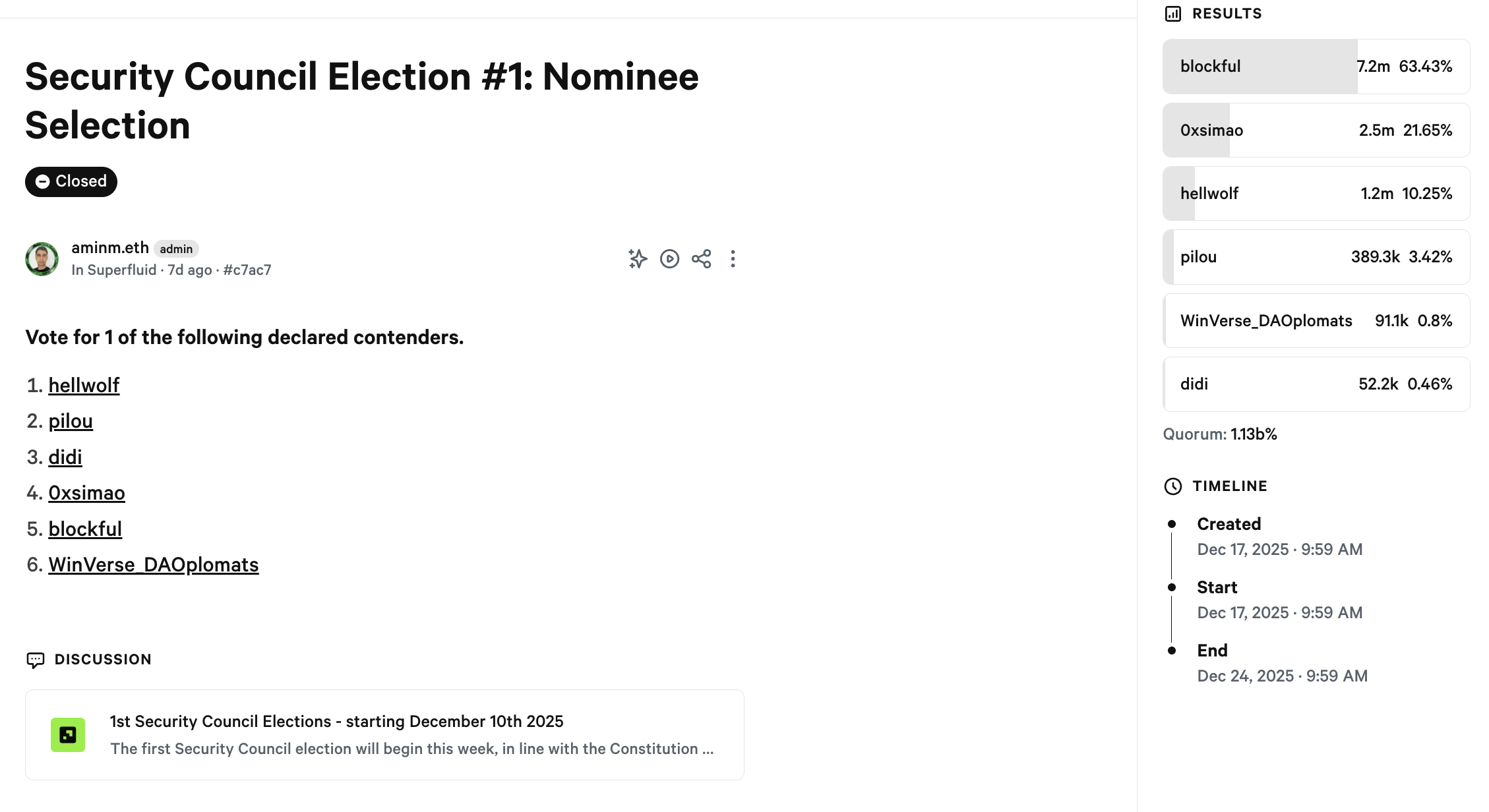
:loudspeaker: Voting for Security Council Election #1: Nominee Selection is now live on Snapshot HERE

Step 2 Nominee Selection is now complete. Thanks everyone who participated in that vote.

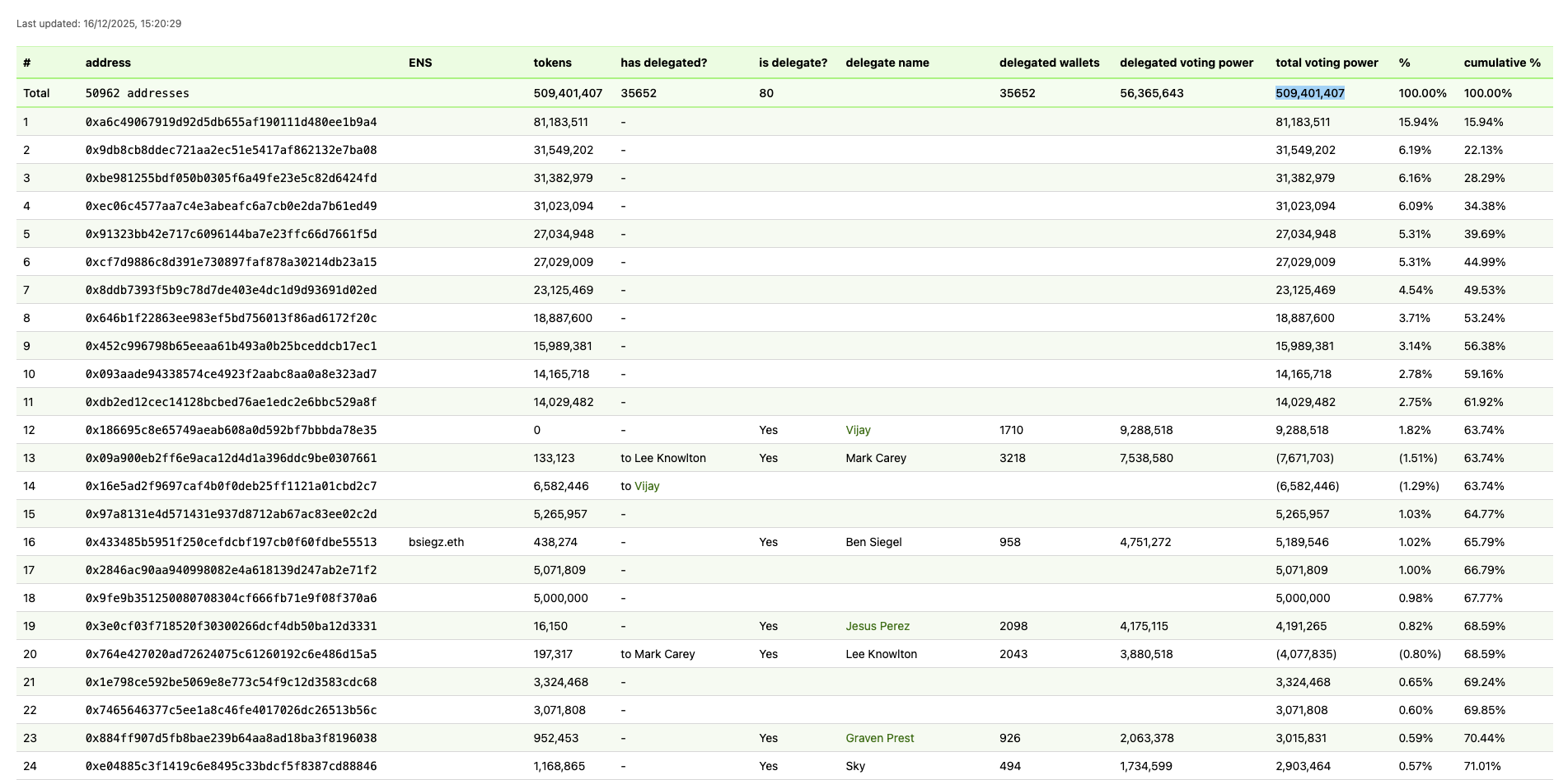
3 candidates were supported by pledged votes representing at least 0.2% of all Votable Tokens (509,401,407 all Votable Tokens x 0.2 % = 1,018,803).

Step 3 Compliance Process will now be coordinated by The Superfluid Foundation in line with the schedule above [December 24 :right_arrow: January 20].

I have some thoughts on this election. I already shared them in the Discord, but was asked to put them up here as well, so here goes…

I was quite surprised by the outcome of this Security Council vote.

I see now that the first post in this thread does mention it, but the notion of ‘all votable tokens’ was not on my radar at all. Right up until the result was posted, I thought all five candidates were above the cutoff.

Even assuming that people are aware of the technicality of ‘all votable tokens’, I think it would be good to make this number very visible on the voting page and also make sure that voters can see directly how each candidate is placing at any moment (ie. percentage of all votable tokens, not just percentage of cast votes).

Such transparency is important for trust and for outcomes reflecting the voters’ actual wishes.

I was wondering about the decision to ask voters to pick only one candidate and place all their votes on that person. Considering that this step was only about nomination, not final selection, and that a group of people was needed, not just one - did you consider making it an approval vote instead? I imagine asking voters to either simply pick all candidates that they would approve of, or split their voting power between those candidates in a weighted manner.

The problem as I see it with the “pick one only” is that potentially everyone’s second pick could end up not being approved for nomination while more divisive candidates would be approved as they would each have at least some voters see them as their first pick. Also, ‘whales’ will heavily weigh against the less popular candidates when they can’t split their votes - even in a case where it might be desirable to nominate more candidates.

The procedure of first electing nominees, then checking up on them and then electing the final council was explained in this thread. I think it would be good to state the procedure directly on the voting page as well. As it was, I would worry that some voters might not have sufficiently understood how placing a lot of votes on the top contenders effectively excluded others from even getting nominated (because they didn’t reach the 0.2% threshold …of all votable tokens).

Might you consider, in the future, to allow tokens that are being used for LP from within a Superfluid reserve to count for voting - similar to tokens that have been staked from within a reserve? There may be good reasons for the difference that I just don’t know about, but to me it seems a bit strange that LP’ing should detract from someone’s voting power.

2 Likes

The fact that whales vote and that their votes carry significant weight can actually be a positive thing. after all, they have committed the most capital. It shows that they are aware of whose hands their funds will ultimately end up in, and that’s not something I would change.

When it comes to transparency around who votes for what, everything is visible on Snapshot https://snapshot.box/#/s:superfluid.eth/proposal/0xc7ac78a1d64db286e3dacfaf7919926dced132b0bba8984bd641f0b26b9a0f82
You can see who voted, for whom, and with how much voting power.

During the voting process itself, it’s already possible to see who voted for what. The only thing that could potentially be adjusted is the visibility of individual votes after the voting has concluded.

1 Like

@joanbp thank you for the thoughtful and detailed feedback. My replies below.

1 . . . would be good to make this number very visible on the voting page

Great suggestion. We can do this for future votes and add the number of the SUP tokens which equate to the 0.2% of Votable Tokens.
For reference, the link to Votable Tokens table is accessible on the Forum from this thread: Delegates and Voting Power [Official] .
Below is a screenshot of that page taken at the time the Snapshot vote was posted.
Adding this figure to the voting page as you suggest would improve transparency.


1 . . . and also make sure that voters can see directly how each candidate is placing at any moment (ie. percentage of all votable tokens, not just percentage of cast votes).

Will check if Snapshot platform which we use for voting can calculate and display percentage of all votable tokens for each candidate at any moment during the vote. If it can do that we will make it visible for future votes.

2 . . . decision to ask voters to pick only one candidate

Appreciate your feedback on this. As you point out, there are downsides to picking only one candidate and picking more than one candidate would be more inclusive.

As it stands, the process for Security Council Elections is detailed in the Constitution. Link to the relevant section of the Constitution is in the first line of this thread.

There was no separate decision (to ask voters to pick only one candidate) beyond following the Constitution. However the DAO can change the process through a Constitutional SIP.

I think your suggestion could improve the process. As this is the first Security Council election, would be good to have more feedback and see if there is broad support to change and improve that process through a Constitutional SIP in the future.

3 . . . state the procedure directly on the voting page as well

Agree that adding more details to the Snapshot voting page can be more helpful.

The Snapshot voting page references the detail proposal text on the Forum, with a link under “Discussion”. In the future, we can add to the voting page more of the text of the Forum post and relevant links.

4 . . . allow tokens that are being used for LP from within a Superfluid reserve to count for voting

This should already be the case. All tokens in Reserves (including LP bucket) should be Votable Tokens in line with the definition of Votable Tokens in the Constitution here. Please let me know if you were unable to vote with any of your tokens - including in the Reserve LP category - so we can look into it.

Thanks again for the helpful feedback to improve the process.

2 Likes

Ah, thanks! I was not complaining about whales having big weight, though.

And my problem is also not the transparency of who votes what.

I was merely talking about the transparency of the voting process and the fact that it might be desirable - for whales and everyone around them - if they (we all) had the option of approving multiple candidates / splitting our votes among multiple candidates in a case like this. I don’t think there should be any technical difficulty in what I suggest.

Thank you for first raising this concern on Discord and now opening this thread here, Joan.

I think it’s important for the OGs in this project to become mindful of and cater to the (very much!) larger audience that this project has garnered since the launch of SUP nearly a year ago; this is especially important in two key and related areas:

  1. Operating as a DAO, Superfluid must not only be mindful of strict adherence to the rules of its founding documents, but also to the appearance of respect for those principles. In the case of the recent Security Council elections, rightly or wrongly, some observers could interpret that process and results as evidence that it was an election “in name only” and that the results were predetermined. If such a view were to become widely held and/or reinforced (or simply not refuted) in subsequent DAO actions, it could be catastrophic for the long-term prospects of the project.

  2. The Forum has functioned as a primary focus for all project-related discussions and planning, and this has worked reasonably well, up to a point. However, it’s important for the core team and investors to understand that, with this new, much wider, DAO membership, the primary focus of engagement has become the Discord server. That is where most questions, answers and ideas are now shared and trying to “force” this new engagement back to the Forum in order for it to have any legitimacy ignores reality. “The times they are a-changing” and the DAO must change along with them or (again, as in #1 above) risk being viewed as a DAO in name only that is, in reality, tightly controlled by a small group of insiders.

Accordingly, I strongly support the following procedural updates:

  1. All future Snapshot votes should be preceded by a live AMA discussion of the issue or (in the case of elections) interview with the candidates to be conducted either within Discord or on X.
  2. There should be dedicated Discord server channels for the discussion of various topics that might lead to formal Forum proposals. For example, topics such as: marketing ideas, treasury yield opportunities, killer apps, etc. This will both foster a stronger sense of “ownership” throughout the DAO and, quite possibly, bubble-up some great ideas that might otherwise never reach the eyes and ears that could actually bring them to life.
  3. I encourage the team to consider holding regularly scheduled free-form (no specific topic or agenda) “office hours” within the Discord server. Essentially, an informal Q&A with one or two team members where anyone can drop in to chat, ask questions, or just listen.

If I were to pick a single word to sum this all up, it would be: “transparency.” That principle needs to be top-of-mind in all DAO planning and actions as this project moves forward. Superfluid has just entered upon a new and critical growth phase, and we need to recognize this and “get it right.”

2 Likes