Abstract
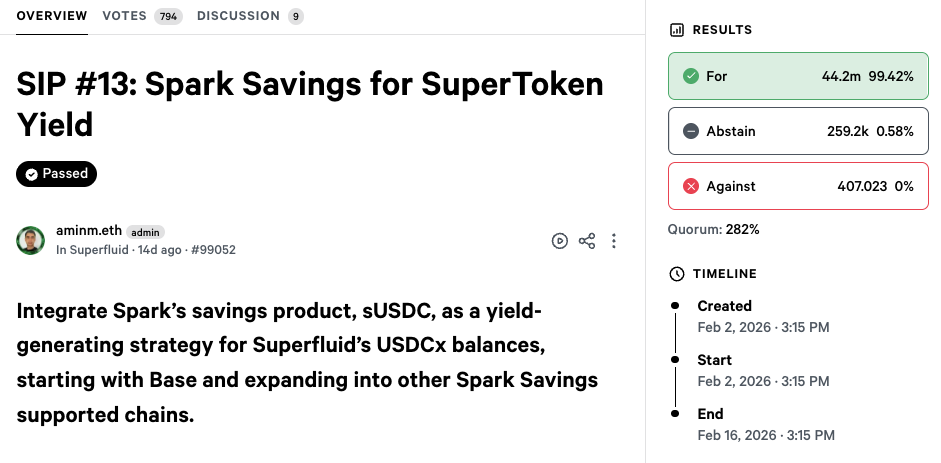
This proposal outlines a partnership between Spark and Superfluid to integrate Spark’s savings product, sUSDC, as a yield-generating strategy for Superfluid’s USDCx balances, starting with Base and expanding into other Spark Savings supported chains. Under this proposal, USDCx held by the Superfluid DAO would be allocated into the Spark USDC savings vault, allowing the DAO to earn yield generated by the Sky Savings Rate. This integration establishes Spark as a yield layer for Superfluid stablecoin balances, beginning with USDCx and remaining extensible to future savings tracks.
Type
Non-Constitutional
Motivation
Superfluid DAO voted for [SIP #9] to Turn ETHx and USDCx into yield for the DAO . Allocating USDCx components of these balances into the Spark USDC savings vault enables the DAO to earn a stable, risk-adjusted yield on USDCx while preserving liquidity, transferability, and composability.
Spark USDC currently generates approximately 4% APY, which is higher than the USDC supply rates on major lending protocols such as Compound V3 and Aave V3. This yield is derived from protocol revenue rather than incentives and accrues continuously, making it suitable for treasury-level capital deployment. Spark Savings functions as a treasury management solution comparable to a fixed-income yield facility, offering competitive rates alongside instant liquidity with support for billions of dollars in capacity.
Spark Savings’ key partners include OKX CEX & DeFi Earn, Binance Wallet, Base App, Cobo, and other ecosystem participants.
Rationale
Spark is an on-chain capital allocator designed to optimize stablecoin liquidity through programmatic deployment across decentralized finance, centralized finance, and real-world asset markets. Spark was launched in 2024 as part of MakerDAO, now Sky, and currently manages approximately $9.9B in total value locked, making it one of the largest on-chain capital allocators.
Spark’s flagship product, the Spark Liquidity Layer, automatically allocates stablecoins sourced from Sky into blue-chip DeFi protocols across multiple networks while extending yield generation into overcollateralized real-world asset markets. Spark has allocated approximately $630M to Maple Finance as part of this strategy.
The design of sUSDC aligns with [SIP #9] goals to enable the DAO to invest the underlying asset and accrue yield income to its treasury. sUSDC accrues yield in real time, is implemented as a standard ERC-4626 vault, and maintains full liquidity through the Spark Peg Stability Module. Adopting sUSDC as the yield-generating layer for USDCx allows Superfluid to utilize a governance-controlled, audited, and non-incentive-based yield source.
Key Terms
sUSDC is an ERC-4626 representation of USDC deposited into the Spark USDC savings vault. The token increases in value as yield accrues and can be transferred, staked, or integrated into other protocols.
The Sky Savings Rate is a savings rate paid in USDS to USDS depositors. The rate is funded by borrowing fees accrued by the Sky Protocol and is set through Sky governance. As of December 2025, the Sky Savings Rate is 4% APY.
USDCx is Superfluid’s upgraded USDC token that enables real-time streaming functionality.
Specifications
Saving USDC through sUSDC allows depositors to earn yield generated by the Sky Savings Rate while maintaining exposure to USDC. When USDC is deposited into the Spark USDC vault, the vault converts the USDC into USDS, which is then deposited into the sUSDS contract. The vault receives sUSDS shares on behalf of the depositor and mints an equivalent amount of Spark USDC vault shares.
When USDC is withdrawn, the Spark USDC vault burns the corresponding vault shares, redeems the underlying sUSDS shares, converts the resulting USDS back into USDC, and transfers the USDC to the withdrawing party. This process allows sUSDC to track the Sky Savings Rate while maintaining full liquidity in USDC.
The Spark Liquidity Layer programmatically allocates stablecoins into major blue-chip DeFi protocols across multiple networks and extends yield generation into overcollateralized real-world asset markets, including private credit and Treasury-backed instruments. Yield generated by the Spark Liquidity Layer is routed back to Sky and distributed to sUSDS and sUSDC holders.
Large-scale deposits and withdrawals are supported through the Spark Peg Stability Module, which enables swaps between USDC, USDS, and sUSDS at no slippage, subject only to network fees. This mechanism allows high-capacity entry and exit liquidity for large balances.
Spark USDC currently generates approximately 4% APY. This savings rate is higher than the supply APY of USDC across major lending markets and is not dependent on liquidity incentives or reward programs. Yield accrues continuously and can be withdrawn at any time.
Steps to Implement
Following governance approval, the Superfluid DAO would integrate the Spark USDC savings vault as the yield strategy for USDCx balances held by the DAO. This includes configuring a strategy module or contract that routes USDCx balances into the Spark USDC vault while maintaining compatibility with Superfluid’s real-time asset streams.
Prior to deployment, a technical review of Spark’s audited contracts would be conducted by Superfluid team. Standard legal review and DAO procedures would be followed for interaction with a third-party protocol. Upon completion of the integration, USDCx balances would be deployed into sUSDC and begin accruing yield automatically without further operational intervention.
Timeline
-
Call for voting - 7days
-
Vote - 14 days
-
Waiting period - 3 days
-
Technical review by Foundation Engineering team - 7 days
-
Integration - 7 days
-
Deployment by Security Council
Overall Cost
The overall cost of implementation for the Superfluid DAO is expected to be low (subject to Technical Review). The Spark USDC savings vault is implemented as a standard ERC-4626 vault, which aligns with existing industry conventions for yield-bearing asset integrations and does not require bespoke protocol development or custom infrastructure.
Implementation costs are limited to standard engineering time for integration and testing, routine smart contract deployment, and associated gas fees. No licensing fees, incentive commitments, or recurring payments to Spark are required. Ongoing operational overhead is expected to be minimal and limited to standard monitoring processes already maintained by the Superfluid DAO.
Reference
 Voting for SIP