As a SUP DAO delgate, I would like to put forth the following proposal. It has been authored by the Superfluid Foundation and revised based on feedback from myself and others. In my opinion, this proposal provides strong support to $SUP while rewarding stakers and liquidity providers. Feedback is appreciated.
Abstract
This proposal specifies the details of SUP staking and Liquidity Provision within the Reserve mechanism and approves a DAO contribution to start SUP staking pre-transferability.
Type
Constitutional [modifies Reserves]
Motivation
Staking rewards and Liquidity Provision through Reserves add rewards functionality to SUP, allows holders to signal commitment, and supports price stability of SUP.
Launching staking before transferability brings forward the rewards functionality of SUP.
Rationale
Staking rewards, Liquidity Provision and minimum staking periods reduce SUP sell pressure post-transferability.
Reserves - Individual smart contracts, whose upgradeability is controlled by governance. See Technical Overview
Staking Rewards Controller - Smart contract managing distribution of Staking and Liquidity Provision rewards. See GitHub link
Specifications
1. Reserve functions
Reserves will have the following functions:
Stream - Withdraw SUP linearly over up to 12 months
Stake - Stake SUP to earn additional SUP
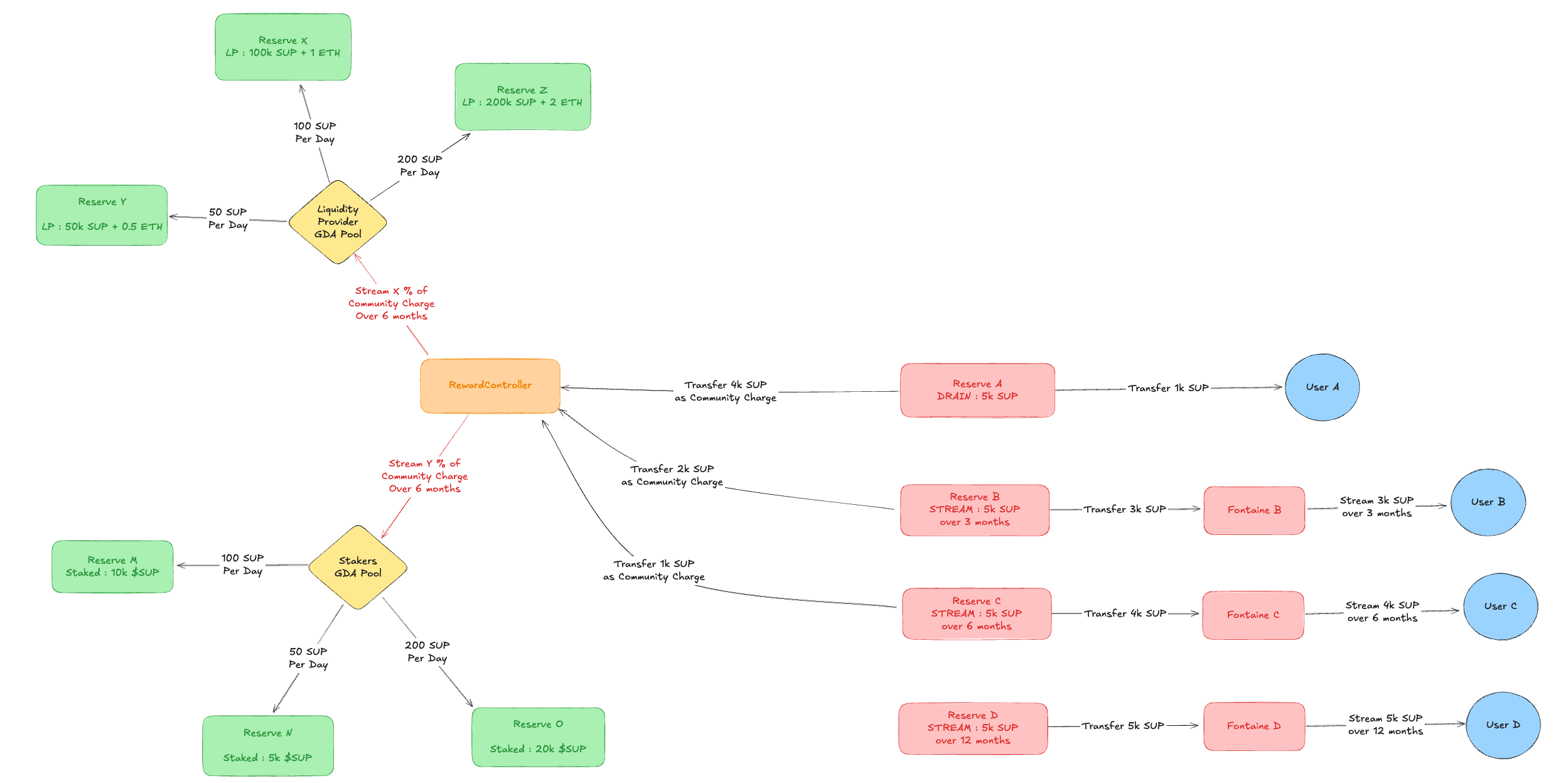
Drain - Immediately withdraw 20% of SUP; remaining 80% is redirected as a Community Charge and streamedto Stakers and Liquidity Providers
LP - Add an equal amount of ETH, and allocate your reserve SUP to the ETH/SUP Uniswap pool to earn trading fees and SUP yield. Liquidity Providers who have provided liquidity for at least 6 months have the option to withdraw their SUP (and ETH) directly to their wallet without incurring the Community Charge.
2. Accrual of Staking and LP Rewards
Rewards accrue from two sources:
Community Charges collected through users who choose the Drain option will be allocated to Stakers and Liquidity Providers
DAO Treasury: Initial seed of 1M SUP from DAO Treasury so that staking can begin before any Community Charge has accrued pre transferability
3. Distribution
Staking Rewards Controller distributes its SUP holding to Stakers and Liquidity Providers via a linear stream over 6 months.
As an interim measure until the DAO decides otherwise, Superfluid Foundation is requested to determine the split of Rewards between the Stakers GDA pool and Liquidity Providers GDA pool.
Within each of the Stakers GDA pool and the Liquidity Providers GDA pool, each recipient’s share of the flow rate will be according to the amount of SUP they have Staked or LP’d.
Every Community Charge generation event will update the flowrates to Stakers GDA Pool and Liquidity Providers GDA Pool and restart the 6 months linear streaming.
Rewards are streamed directly to Reserve contract.
4. Eligibility
Any SUP holder with a Reserve can :
stake once staking is enabled.
provide liquidity once liquidity provision is enabled
Staking or liquidity provision requires an available balance of SUP within the Reserve.
5. Minimum Staking Period
Minimum Staking Period feature for Reserves will be set to 30 days such that users will be able to unstake anytime after 30 days have passed since their last staking.
Partial or full unstaking will be supported.
6. Minimum Liquidity Provision Period
Minimum Liquidity Proision Period feature for Reserves will be set to 7 days such that users will be able to withdraw their LP position from Uniswap anytime after 7 days have passed since their last Liquidity Provision event.
Partial or full liquidity withdrawal will be supported.
Steps to Implement
Foundation engineering team completes development of Reserve staking features (estimated < 1 week).
Transfer 1,000,000 SUP from DAO Treasury to Staking Reward Controller.
Enable Staking
Timeline
Call for voting - 7days
Vote - 14 days
Waiting period - 7 days
Execution by Security Council
Overall Cost
Engineering - No material additional costs.
SUP Budget - 1,000,000 SUP from DAO Treasury allocated to staking rewards.
Thanks for your proposal! It is an important step towards the TTE, and I have a few questions.
Here, I assume the reserve will increase with upcoming streams from SPR events and be reduced by the stream or drain function.
Does this mean that the SUP collected by the charge is added to the pools (in the ratio defined by the Foundation) and the stream restarts? A chart or diagram would be helpful for better understanding.
It would be interesting to add that this is managed using the Uniswap v3 NFTs (so we can have multiple LPs within our reserve), each one with their own 6-month timer
How exactly will this function work?
Stream:
I assume I can select the amount of this stream (and the duration, as per the docs). Does that mean that I can have part of my reserve staked, part as LP and part as stream, right?
There will be a multiplier for longer staking periods?
PS: the Staking section in the docs is outdated (mentioning a 7-day cooldown period).
That is correct, LP will be managed by Uniswap V3 Pools. Users’ Reserves will be the owner of these position NFT.
Every time a user provide liquidity (through their reserve), a new position is created and the 6-months timer timestamps is recorded. No hard limit on the number of LP position a reserve can own.
At the moment, no plans for adding a multiplier applying to longer term stakers, but that could be indeed interesting to think about.
I don’t think I understand what you mean here. Could you elaborate further ?
Yes indeed! good catch, the documentation will be updated shortly.
This is an interesting and important next proposal after the transferability prop passed. We love how the team is thinking regarding the reserve functions here, especially the 20/80 split in the drain function. The diagram from pilou is really helpful too.
A few things we would love to touch.
On this,
Would this split by the FDN be communicated to the community? Also, it would be great to ensure the effects of the split is monitored so it can always be adjusted as needed.
Having this and/or restaking options included will definitely make this proposal more robust.
Looking at the proposal more broadly, we don’t see any plan to bake in delegation via staking. Staked tokens should be able to delegate their voting power. We have some interesting ideas on how this can be implemented, and we believe it would be good to explore, as it would further incentivize governance participation.
Yes the initial allocation split determined by Superfluid Foundation will necessarily be communicated to the community as the DAO will set these parameters.
It will be fairly easy to monitor and evaluate the pertinence of this setting by observing the yield inherent to staking or liquidity providing.
What do you means by restaking options ?
Staked SUP will remain in each user’s reserves. therefore, delegation power before or after staking / unstaking will be unchanged.
For clarity, does this mean that when staking $SUP, the $SUP tokens actually stay in the user’s reserve? As opposed to being deposited in a staking contract (as is typical)…
Yes indeed, Staked $SUP remain in the user’s reserve. The reserve has some accounting logic that can differentiate the available balance and staked balance.
This allow delegation power accounting to be simple.
Usually, there is a staking timeline made available for stakers — six months, one year, two years…
In such conditions, restaking is the option to stake again for another period of time of your choosing, after your initial stake unlocks. It usually comes with additional perks.
The following reflects the views of the Lampros DAO governance team, based on our combined research, analysis, and ideation.
We are voting in support of SIP-8.
This proposal introduces staking and liquidity provision for SUP through the Reserve mechanism, and we see it as an important step to strengthen the token economy before transferability.
It gives holders a clear way to demonstrate commitment while also setting up healthier incentives for the long term. We believe the design is well thought out because the Community Charge channels value back to stakers and liquidity providers instead of rewarding short-term selling.
The inclusion of minimum periods for staking and liquidity provision further helps reduce quick in-and-out behavior that could otherwise create unnecessary sell pressure. Another aspect we appreciate is that staking does not interfere with delegation power, which ensures that governance participation remains intact.
At the same time, we think it will be useful for the DAO to commit to reviewing and reporting the reward split between stakers and liquidity providers on a regular basis. This will keep incentives balanced and responsive to real usage. Sharing clear data on staking uptake, liquidity performance, and community charge flows will also allow the community to better evaluate whether the system is achieving its goals.
Overall, SIP-8 aligns incentives, supports SUP stability, and prepares the ground for transferability. We are glad to support it.
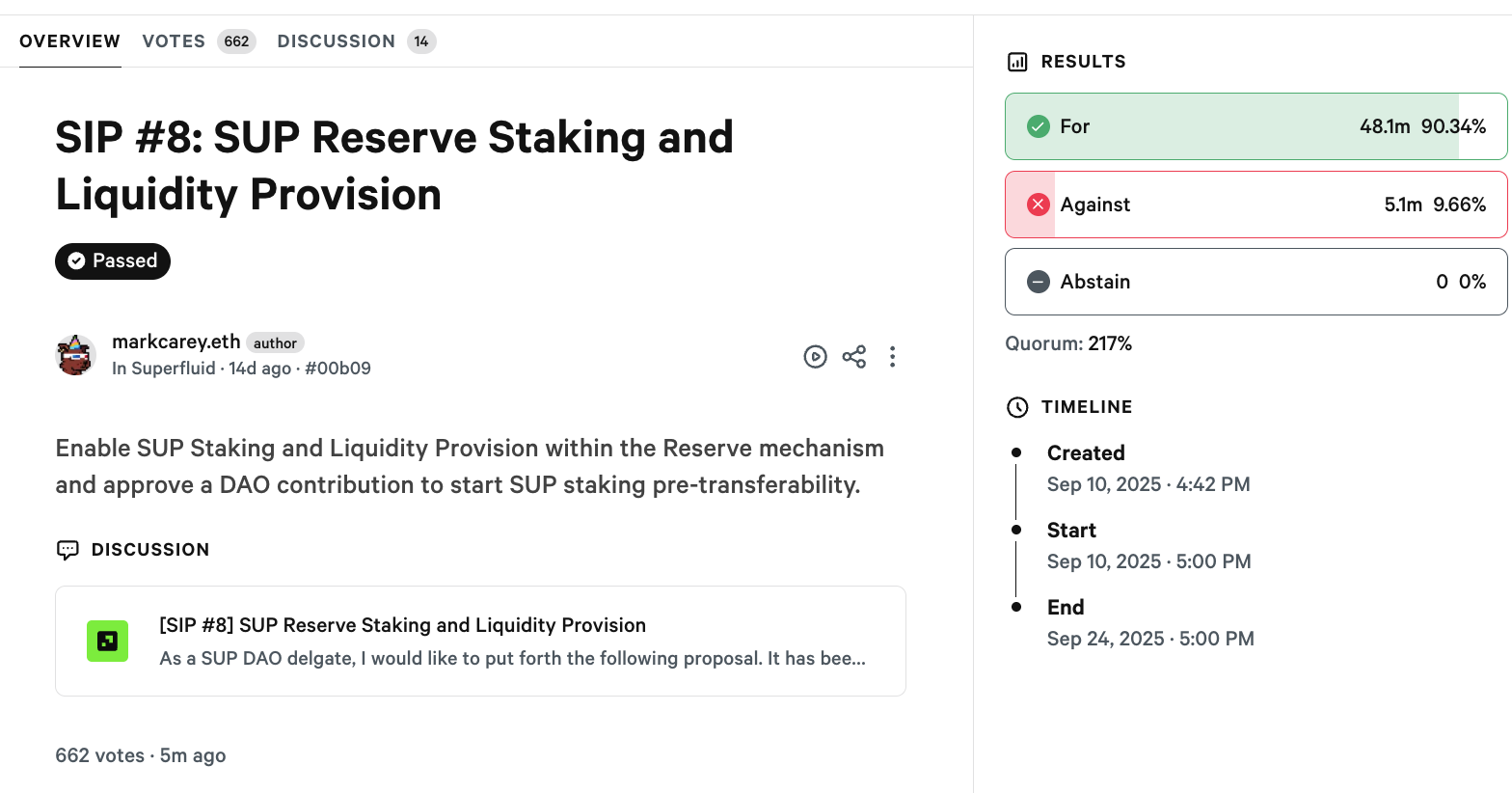
Voting period has ended for [SIP #8] SUP Reserve Staking and Liquidity Provision.
The proposal passed with 90.34% votes For.
Results available here on Snapshot.
Implementation update:
SUP Reserve Staking is now live here.
Thanks again to everyone who contributed to this discussion.
Liquidity Provision to go live at SUP Transferability, based on the process approved by the DAO under [SIP #7] SUP Transferability.
 Voting for SIP