Abstract
This proposal outlines a partnership between Origin Protocol and Superfluid to integrate Origin Protocol’s yield-bearing stablecoin, Origin Dollar (OUSD), as a diversified yield-generating strategy for Superfluid’s USDCx balances alongside Spark’s sUSDC. Under this proposal, USDC held by the Superfluid DAO would be allocated across a set of risk-adjusted yield strategies, allowing the DAO to earn higher yields than those generated solely by the Sky Savings Rate. This integration positions Origin Protocol as a yield option for Superfluid balances, beginning with USDCx.
Type
Non-Constitutional
Motivation
There was interest from the Superfluid DAO to earn a yield on treasury assets, as the DAO voted for [SIP #9] to Turn ETHx and USDCx into yield for the DAO. Aave was the initial decision, but as seen from recent reports signal Aave is no longer a safe protocol to park funds.
The DAO also voted for [SIP #13] Spark Savings for SuperToken Yield - to which delegate @jensei brought up the question if SIP 13 was exclusive to Spark, which received no opposition.
By splitting the USDCx components between Origin’s OUSD and Spark’s SSR, the Superfluid DAO can increase the yield the treasury is generating, while also removing the risks and reliance that come with using a single yield source, all while still preserving liquidity, transferability, and composability.
Paired with SSR’s current 3.75% APY, Origin Dollar is currently yielding 5.5% APY. OUSD’s yield comes from a mix of sources separate from SSR, while still allowing the Superfluid DAO to maintain custody the entire time.
Origin’s key partners include Morpho, Curve, Yearn, and other large ecosystem participants.
Rationale
Origin Protocol is an established, well-funded, registered business in the Cayman Islands that provides fully decentralized, risk-averse stablecoin and ETH yields. Origin was founded by Web3 veterans Josh Fraser and Matthew Liu in 2017 and is one of the most venerable projects in the space. Josh and Matthew are joined by the fully doxxed Origin team and community, which includes hundreds of thousands of members and open-source contributors.
Origin Protocol’s first Defi product, the Origin Dollar, is yield-generating stablecoin that rebases positively to distribute yield directly to user wallets. OUSD rebases are daily and up only, without users needing to claim yields.
OUSD’s design aligns well with [SIP #9] goals to enable the DAO to invest the underlying asset and accrue yield income to its treasury, while maintaining full liquidity the entire time. Adopting OUSD as a second yield-generating option alongside sUSDC for USDCx allows Superfluid to generate yield across multiple governance-controlled, audited, and non-incentive-based yield sources.
Specifications
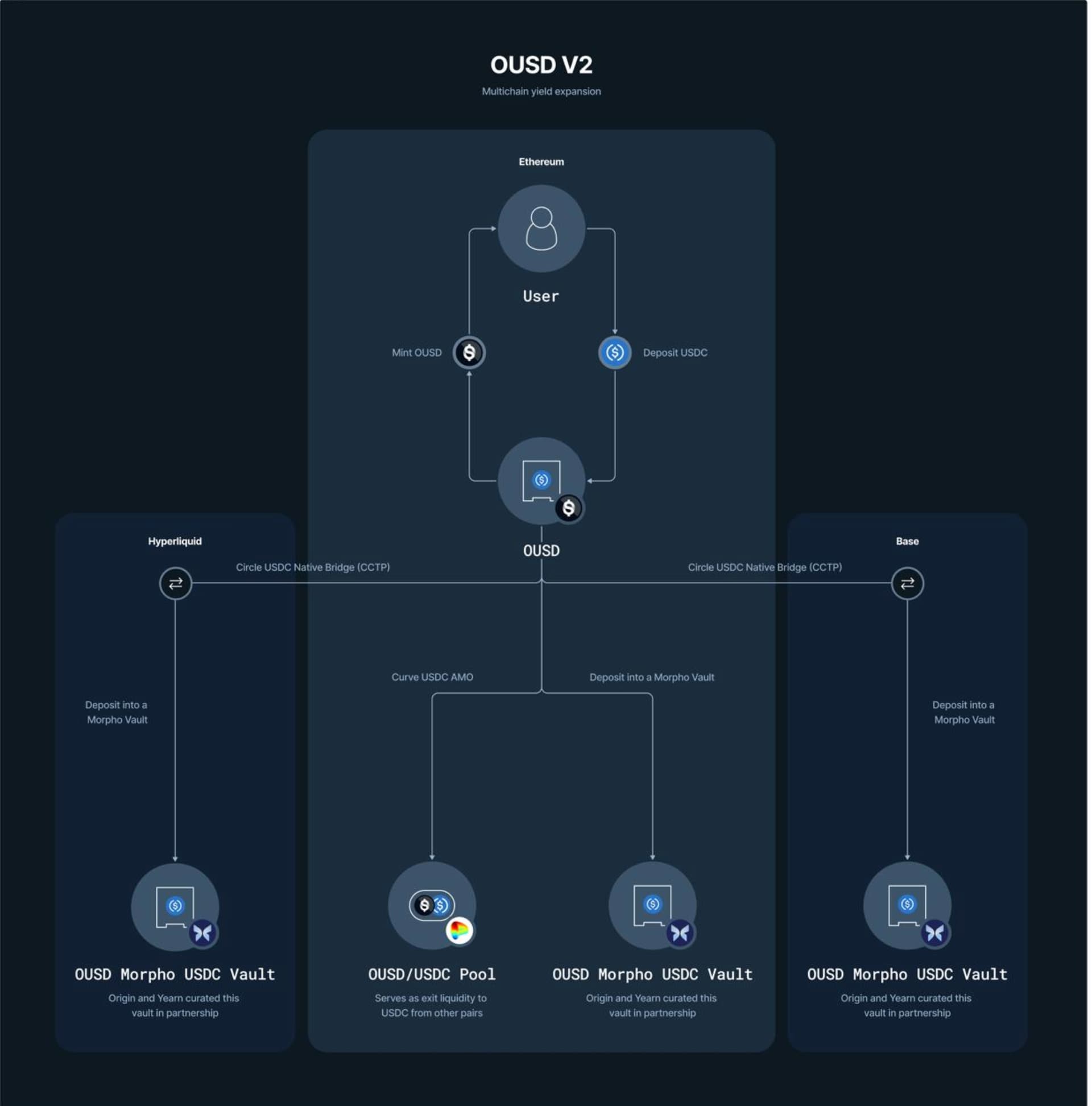
OUSD is an ERC20 stablecoin that generates yield while sitting in your wallet or multi-sig. Backed 1:1 by USDC, holders can go in and out of OUSD as they please. Yield is paid out daily and automatically (sometimes multiple times per day) though a positive rebase in the form of additional OUSD, proportional to the amount of OUSD held. OUSD yield, currently ~5.5% APY, comes from a combination of:
- Deploying USDC collateral to a Curve AMO
- Lending USDC collateral to Morpho on ETH mainnet, Base, and Hyperliquid
- Reward tokens (MORPHO, CRV, and CVX) are automatically claimed and converted to stablecoin
- OUSD sitting in non-upgradable contracts does not rebase, instead the interest generated from those tokens is provided to those that can rebase
Current and historical OUSD yields can be seen via the OUSD analytics page at all times. Proof of Yield tracks every OUSD yield event as the yield is distributed.
There is no set emission schedule for OUSD - similar to stETH, OUSD is minted on demand when users deposit their stablecoin into the protocol, and burned on demand when users redeem OUSD for the collateral USDC. OUSD is completely non-custodial, there are no lock-ups, terms, or conditions. Any web3 wallet can support OUSD and its rebasing function, including hardware wallets and multi-sigs. There is no need to ever again give up the keys to a 3rd party platform, such as Celsius, Blockfi, or FTX, to earn yield.
A visual representation of OUSD’s design appears as follows:
Similar to sUSDC, there is a corresponding tokenized vault version of OUSD, which is wOUSD. wOUSD is a ERC-4626 tokenized vault designed to accrue yield in price rather than in quantity. When you wrap OUSD, you get back a fixed number of wOUSD tokens. This number will not go up - you will have the same number of wOUSD tokens tomorrow as you have today. However, the number of OUSD tokens that you can unwrap to will go up over time, as wOUSD earns yield at the same rate as standard OUSD. The wOUSD to OUSD exchange rate can be read from the wOUSD contract (function number 16), or via the OUSD dapp.
Current exchange rate as of 3/16/26: 1 wOUSD = 1.27339367 OUSD
Risk Mitigation
There are three risks when using OUSD, and Origin is making sure to reduce each risk as much as possible:
Smart contract risk of the yield strategies - Origin is only using platforms for yield generation that have a proven track record, have been audited, have billions in TVL, maintain a bug bounty program, and provide over-collateralized loans. Over-collateralization in itself, combined with liquidations, provides a reasonable level of security for lenders.
Stablecoin risk - Origin has chosen USDC, one of the largest stablecoins to ever exist, to back OUSD, and it has stood the test of time and maintained its peg quite well through multiple bull and bear cycles. It has also demonstrated significant growth in circulating supply, so the Origin team is confident that USDC will maintain its peg and that OUSD will remain stable. OUSD also uses a Chainlink oracle for pricing data for USDC to ensure accurate pricing at all times. If USDC falls below its $1 peg, OIP-4 disables minting of additional OUSD tokens using the de-pegged asset.
Smart contract risk of OUSD - Origin is taking every step possible to be proactive and lessen the chance of losing funds. Security reviews of OUSD are prioritized over new feature development, with regular audits being done, and multiple engineers are required to review each code change with a detailed checklist. A 48-hour timelock goes into effect before protocol upgrades are launched, and deep dives into the exploits of other protocols are constantly being done to make sure the same exploits don’t exist on Origin contracts. Security is extremely important to the Origin team. 12+ audits have been done on the OUSD codebase since 2020, all of which can be seen on Audits - OUSD, and OpenZeppelin is now on retainer. Origin also holds a top five spot on the Immunefi leaderboard for average response time, and maintains a $1m bug bounty.
Steps to Implement
Following governance approval, the Superfluid DAO would integrate the Origin Dollar as a secondary yield strategy for USDCx balances held by the DAO on ETH mainnet. If the DAO prefers to use the rebasing version of OUSD, the steps to implement are:
- Superfluid will convert the USDC into OUSD via any of the following methods:
- Minting via Vault
- Minting on OUSD.com
- Swapping on Curve
- Swapping on a DEX aggregator
- Superfluid will “Opt in” by calling the rebaseOptIn() function
If using a Gnosis Safe-connected wallet, Superfluid will convert the USDC into OUSD using the OUSD dApp within Gnosis, and then will “Opt in” to yield generation by clicking the Opt in button within Gnosis or by calling the rebaseOptIn() function. Origin can also call this function remotely for Superfluid.
If the DAO prefers to use the non-rebasing version of OUSD (wOUSD), the steps to implement are:
- Superfluid will convert the USDC into OUSD via any of the following methods:
- Minting via Vault
- Minting on OUSD.com
- Swapping on Curve
- Swapping on a DEX aggregator
- Superfluid wrap the OUSD into wOUSD via contract or via Origin Protocol dapp
Yield generation for Superfluid will begin within 24 hours of holding the OUSD or wOUSD within the treasury wallet.
Timeline
- Call for voting - 7days
- Vote - 14 days
- Waiting period - 3 days
- Technical review by Foundation Engineering team - 7 days
- Integration - 7 days
- Deployment by Security Council
Overall Cost
The overall cost of implementation for the Superfluid DAO is expected to be low (subject to Technical Review). OUSD is designed to remain pegged 1:1 to USDC, and the wOUSD tokenized vault is implemented as a standard ERC-4626 vault, which aligns with existing industry conventions for yield-bearing asset integrations.
Implementation costs are limited to standard engineering time for integration and testing, routine smart contract deployment, and associated gas fees. No licensing fees, incentive commitments, or recurring payments to Origin Protocol are required. Ongoing operational overhead is expected to be minimal and limited to standard monitoring processes already maintained by the Superfluid DAO.
OUSD Resources:
Homepage: Origin Dollar (OUSD)
Docs: Origin Dollar (OUSD) | Origin
Dapp: https://app.originprotocol.com/
Analytics: https://analytics.originprotocol.com/ousd/collateral